A Manager’s Guide to Supporting Mental Health at Work
This is a guide of how managers can support mental health at work more effectively. Line managers sit on the front line of workplace attendance. They are usually the first to notice changes in behaviour, performance, or attendance patterns. However, without structured guidance, many managers avoid discussing mental health out of fear of saying the wrong thing or worsening the situation.
If you are looking for practical ways on how to support employee mental health at work, establishing clear manager workflows is essential. Read on to find out more about how to support mental health at work.
Spotting the Early Signs of Mental Health
Mental health challenges rarely appear overnight. In most cases, subtle indicators precede an absence episode:
- Changes in Work Patterns: Uncharacteristic lateness, erratic break times, or working late without increased output.
- Behavioral Shifts: Increased irritability, withdrawal from team discussions, or unusual quietness.
- Performance Drift: Difficulty concentrating, frequent small mistakes, or missed deadlines.
- Physical Indicators: Persistent fatigue, frequent minor illnesses (such as headaches or stomach upsets), or noticeable changes in appearance.
Conducting an Effective Early-Intervention Conversation for Support
When a manager notices changes, waiting for a formal review or a sick note is a missed opportunity. Early conversations should be supportive, private, and non-judgmental:
- Choose the Right Setting: Hold the conversation in a private space where you will not be interrupted.
- Focus on Observations, Not Diagnoses: Frame the discussion around observable changes (e.g., “I’ve noticed you’ve seemed under pressure lately and wanted to check in” rather than “Are you stressed?”).
- Listen Without Immediate Problem-Solving: Allow the employee time to speak without interrupting or offering quick fixes.
- Agree on Practical Adjustments: Discuss temporary, reasonable modifications to workload, shift patterns, or duties that might ease immediate pressure.
Managing the Return-to-Work Process to Best Support Mental Health at Work
How an employee is welcomed back after a period of mental health absence strongly influences whether the return is successful or results in a relapse. A structured return-to-work process should include:
- A brief, welcoming meeting on their first day back to reassure them and review duties.
- Phased return arrangements where appropriate (e.g., part-time hours building up over 2 to 4 weeks).
- Regular informal check-ins during the first month to monitor workload and stress levels.
How CWS Workplace Toolkits Transforms Mental Health Absence
At Central Wellbeing Services (CWS), we work alongside HR leaders and business owners/ managers across the East Midlands to implement structured, practical frameworks that lower sickness rates and build organisational resilience.
Unlike generic helpline services, our toolkits integrate directly into your day-to-day operations.
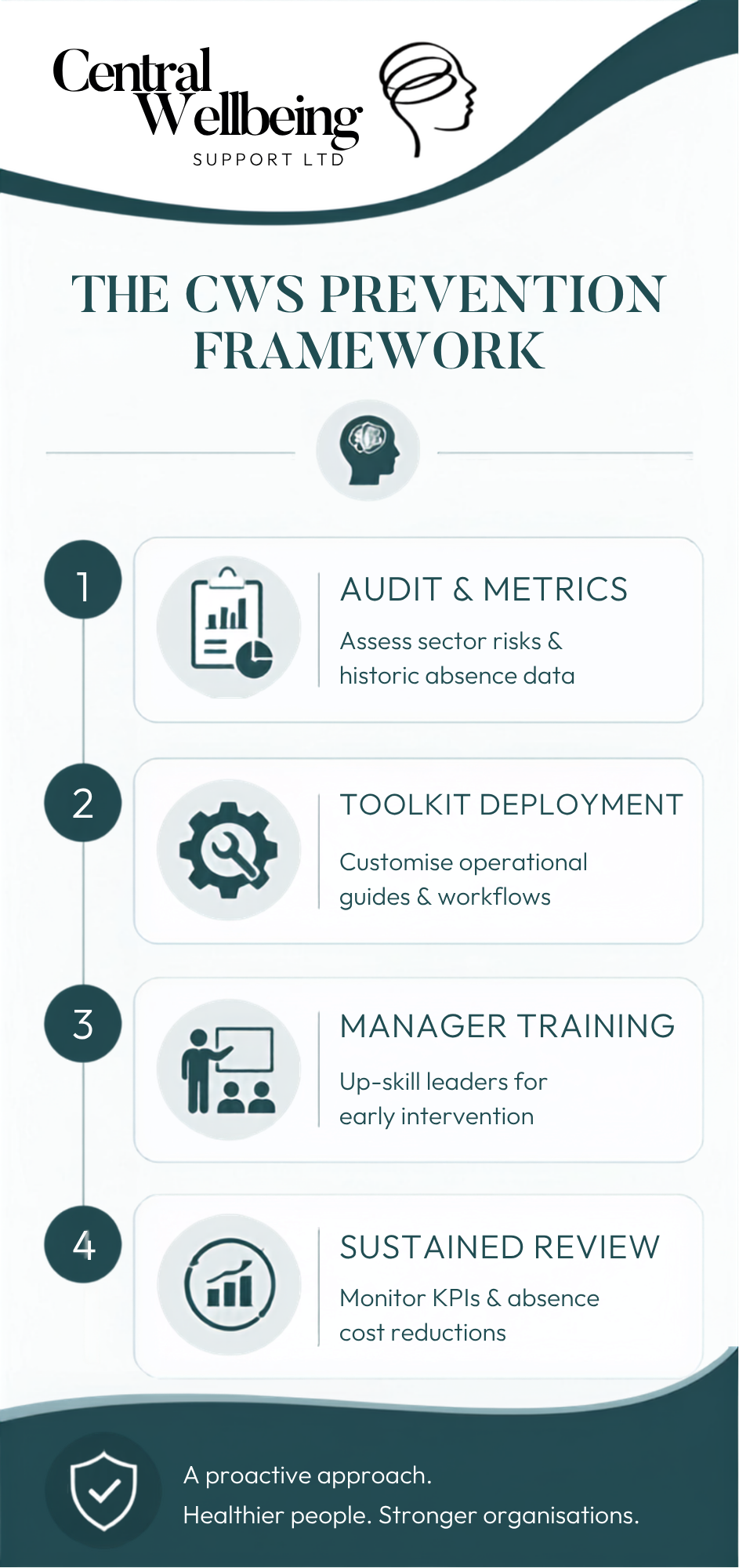
Sector-Specific Customisation for Supporting Mental Health at Work
We understand that an engineering firm in Derby faces entirely different workforce dynamics than an early-years setting in Nottingham. Our toolkits are tailored to your industry’s specific operational realities:
- For Early-Years & Care Settings: Focus on emotional resilience, rotas designed to prevent burnout, and peer support structures. We have hands-on experience working with a local nursery in Stapleford called Jellybeans Childcare, so it’s safe to say we know the same well.
- For Manufacturing & Logistics: Focus on shift pattern adjustment, physical-mental health integration, and accessible support for non-desk-based teams.
Empowering Managers with Actionable Tools
Our approach focuses on upskilling your leadership team. Engaging a specialist equips line managers with practical templates, risk assessment guides, and conversation frameworks, enabling them to manage mental health proactively rather than relying on external helplines.
Steps to Reduce Mental Health Absence
If your organisation is experiencing high sickness absence costs, implementing a structured strategy will yield clear operational improvements.
- Audit Your Absence Data: Look beyond overall absence days. Identify recurring patterns across departments, shift times, and job roles to understand root causes.
- Review Existing EAP Usage: Evaluate the ROI of your current support systems. Check real utilisation rates and determine if your EAP actively prevents sick leave or merely responds to crises.
- Train Your Line Managers: Invest in practical, hands-on training that gives supervisors the confidence to identify stress early and manage sensitive discussions effectively.
- Implement Clear Adjustments Frameworks: Establish transparent policies for temporary work adjustments so managers can act quickly when an employee shows signs of struggle.
- Partner with Workplace Specialists: Work with experienced consultants to build bespoke toolkits aligned with your operational goals and industry demands.
Transform Absence Management in Your Workplace
Unmanaged mental health absence places an unnecessary burden on your teams and financial performance. Moving away from passive, generic EAPs toward targeted workplace toolkits allows you to protect your employees’ wellbeing while safeguarding your business operations.
Whether you operate in early-years education, manufacturing, or professional services across the East Midlands, Central Wellbeing Services (CWS) can help you build a resilient, productive workforce.
Take the first step toward reducing staff absence mental health and contact us today to discuss your organization’s specific challenges or to book an initial workplace consultation with our specialist team.
How to Reduce Staff Absence Caused by Mental Health
When an employee takes time off for a physical injury, the path to recovery is usually clear. However, when absence is driven by work-related stress, depression or anxiety, the situation is often much more complex.
According to the latest figures from the Health and Safety Executive (HSE), 964,000 workers reported experiencing stress, depression or anxiety caused or made worse by work. This accounts for a staggering 52% of all work-related ill health in the UK.
For business owners and HR managers, these statistics translate into a daily reality of disrupted operations, increased pressure on remaining staff and spiralling costs. Ignoring the issue is no longer an option. The most effective way to protect your business is to invest proactively in your team. This article outlines exactly how organisations can bridge the gap between wellbeing policy and daily practice to reduce mental health absence.
The True Cost of Mental Health Absence in the UK
Before implementing solutions, it is crucial to understand what is at stake. Recent government data from the Keep Britain Working Review highlighted that replacing an employee lost to ill health costs an employer over £11,000 on average. Furthermore, each sickness absence day costs a business an estimated £120 in lost profit.
Beyond the financial impact, employers in the UK have a strict legal obligation. Under the Health and Safety at Work Act 1974, your duty of care extends to psychological risks just as it does to physical hazards. Failing to conduct stress risk assessments or neglecting to support staff who are visibly struggling can leave your organisation exposed to severe legal and reputational damage.
Move from Reactive to Proactive Employee Wellbeing
The biggest mistake businesses make is waiting for a crisis. If you only address employee wellbeing when someone hands in a sick note, you are already too late.
Reducing absence requires a structural shift. It means equipping your leadership team to spot the early signs of burnout before they escalate into long-term leave. Are staff members uncharacteristically withdrawn? Are there sudden spikes in minor illnesses, which often mask underlying stress? By normalising regular check-ins, you create a workplace culture where concerns can be raised and managed early.
Practical Strategies to Reduce Staff Absence
Meaningful wellbeing support is not about installing a ping-pong table or offering a one-off resilience seminar. It requires consistent and structured action. Here is how you can implement this in your workplace:
1. Provide Regular Forums for Managers
Line managers often carry the burden of their team’s mental health alongside their own workload. They need safe spaces to discuss challenges and share solutions. Implementing Monthly Group Support gives your managers and mental health champions a structured, ongoing forum delivered via video conference. This ensures they always have access to a comprehensive wellbeing toolkit and expert guidance to help them manage their teams confidently.
2. Tailor Support to Your Workplace Environment
Every workplace has unique pressures. What works for a quiet corporate office will not work for a high-intensity early years setting or a busy manufacturing floor. Sometimes the best way to uncover and resolve systemic stress is by bringing an expert directly into your environment. Booking an Individual In-Person workplace visit allows a consultant to assess your specific challenges and tailor the implementation of a wellbeing toolkit to suit the exact needs of your business.
3. Document Your Wellbeing Actions
Good intentions do not hold up under scrutiny from inspectors or employment tribunals. Whether you are dealing with HSE management standards or industry-specific compliance like Ofsted requirements, you need a clear audit trail. Documenting your wellbeing programme proves that your commitment is genuine and ongoing.
Why Professional Workplace Mental Health Guidance Matters
Navigating workplace mental health can feel overwhelming. Many business owners want to do the right thing but worry about saying the wrong words or overstepping boundaries.
At Central Wellbeing Support, we base our guidance on logic, common sense and real-world experience. Based in Nottingham, we support businesses across the East Midlands and the wider UK to build resilient workforces. We understand that effective support must be practical and actionable on a busy Tuesday morning, not just theoretical.
Protect Your Team and Your Bottom Line
Investing in mental health is not just a compliance exercise. It is the single most effective strategy for reducing staff absence, retaining experienced professionals and fostering a highly motivated workforce.
Are you ready to stop reacting to absence and start preventing it? Contact us today for a free, no-obligation conversation about how Central Wellbeing Support can protect your team and your business.
What is an Employer’s Duty of Care for Mental Health in the UK?
In the modern workplace, understanding your employer’s exact duty of care for mental health in the UK is no longer a “soft” HR topic – it is a rigorous statutory requirement. As an employer, failing to address psychological risks is viewed by the law with the same gravity as failing to guard a piece of heavy machinery.
For business owners and HR directors, navigating the intersection of statutory legislation and common law is vital to protecting both your staff and your organisation from legal risk.
The Pillars of Legal Duty: What the Law Says
The UK legal framework for mental health at work is built upon three primary pieces of legislation. Together, these form the basis of an employer’s legal duty of care.
1. Health and Safety at Work etc. Act 1974
Under Section 2 of this Act, employers have a general duty to ensure, so far as is reasonably practicable, the health, safety, and welfare of all employees. Crucially, “health” includes mental health. This means you are legally required to provide a working environment that does not cause mental injury or aggravate existing conditions.
2. Management of Health and Safety at Work Regulations 1999
These regulations require employers to carry out “suitable and sufficient” risk assessments for all risks to their employees’ health and safety.
- The Mandate: Employers must proactively identify workplace factors – such as excessive workload, lack of control, or poor workplace relationships – that could lead to work-related stress and mental ill-health.
- The Evidence: If you employ five or more people, these risk assessments and your findings must be recorded in writing.
3. Equality Act 2010
The Equality Act protects employees with “disabilities,” which the law defines as a physical or mental impairment that has a “substantial and long-term adverse effect” on their ability to carry out normal day-to-day activities.
- Reasonable Adjustments: If an employee’s mental health condition meets this threshold, you have a legal obligation to make reasonable adjustments. This might include flexible working hours, changes to the physical environment, or altered responsibilities to ensure they are not disadvantaged.
The Concept of “Foreseeability”
In common law, an employer is only liable for a psychiatric injury if it was reasonably foreseeable. However, the threshold for what is “foreseeable” has lowered significantly as public and legal awareness grows.
If an employee has flagged they are struggling, if absence rates in a specific department are spiking, or if a role is known to be high-pressure, the law assumes the employer “ought to have known” there was a risk. Ignoring these signs is often where severe legal breaches occur.
How to Support Employee Mental Health at Work
Meeting your legal duty of care isn’t just about avoiding an employment tribunal; it’s about creating a culture where staff can thrive. To effectively implement how to support employee mental health at work, consider these four pillars:
- Risk Management: Conduct regular stress risk assessments using the HSE Management Standards (Demands, Control, Support, Relationships, Role, and Change).
- Manager Training: Ensure your leadership team can spot the early signs of burnout and knows how to conduct sensitive “wellbeing check-ins.”
- Accessible Support: Provide pathways to professional, tailored care that staff can access without fear of judgment.
- Clear Policies: Have a robust workplace mental health policy that is communicated clearly from the top down.
Your Local Partner for Employee Wellbeing Support in Nottingham
Navigating the complexities of employment law and mental health needs can be daunting. You don’t have to do it alone.
Central Wellbeing Support provides specialist workplace mental health guidance in Nottingham, helping businesses bridge the gap between legal compliance and genuine care. We offer tailored, practical solutions designed to meet the specific needs of professional organisations, including:
- Targeted Workplace Support: Practical, individual, and group support sessions tailored to protect your workforce.
- Stress Auditing: Helping you identify workplace stressors and psychosocial risks before they become legal or financial liabilities.
- Training & Strategy: Empowering your Nottingham-based team with the tools to manage mental health proactively.
Protecting your employees is a legal obligation, but supporting them is a strategic advantage. By investing in professional employee wellbeing support, you reduce absenteeism, improve retention, and build a resilient workforce.
Take the Next Step in Your Duty of Care
Are you confident that your current workplace mental health strategy meets UK legal standards? Don’t wait for a crisis to find out.
Contact Central Wellbeing Support today to learn more about our comprehensive packages and ensure your team has the expert care they deserve.
For further reading on official standards, visit the Health and Safety Executive (HSE) or consult the Equality and Human Rights Commission (EHRC).
Mental Health Support for Nursery Staff: What Every Nursery Manager Needs to Know
If you manage a nursery, you already know that your team gives a lot. The physical demands, the emotional weight of caring for young children all day, the staffing pressures, the ratios, the Ofsted cycles, it adds up in ways that a standard employee wellbeing programme is never quite designed to account for.
The data reflects what many nursery managers are already experiencing on the ground. A major survey by Nursery World found that one in four early years workers is considering leaving the sector because of stress and mental health problems. The Early Years Alliance reported in 2026 that staffing costs are rising by an average of 15%, with settings losing experienced practitioners faster than they can replace them. When people leave, the remaining team absorbs more pressure. More pressure leads to more burnout. More burnout leads to more people leaving. It is a cycle that starts with overlooked wellbeing.
This is not a marginal issue. It sits at the centre of how sustainable your setting is.
Why Nursery Staff Wellbeing Is Different
The early years workforce faces a combination of stressors that most generic workplace wellbeing guidance was not written with in mind. Nursery practitioners are in sustained emotional contact with young children and their families throughout the working day. The relational demands of that role, being present, patient, regulated, and warm, hour after hour are significant and largely invisible in how the sector talks about workload.
Add to that the physical demands of the environment, the administrative pressure that falls on room leaders and managers, the impact of staff shortages on those who remain, and the particular anxiety that surrounds Ofsted preparation, and you have a workforce that is carrying a great deal with very little formal support in place.
Mental Health UK’s Burnout Report 2026 found that nine in ten UK adults experienced high or extreme levels of pressure and stress in the past year. In the early years sector, the structural conditions that drive those numbers, high emotional labour, under-resourcing, limited autonomy, and persistent uncertainty, are concentrated and consistent in a way most other sectors simply do not match.
What Ofsted Now Expects to See
There is also a compliance dimension to this that every nursery manager needs to be aware of.
Ofsted’s renewed inspection framework, introduced from November 2025, made staff wellbeing a formal inspection requirement for the first time. Under the updated framework, inspectors assess staff wellbeing as part of the leadership and governance evaluation. Settings are expected to demonstrate how leaders actively support the workload and mental health of their teams, not simply acknowledge that it matters, but show evidence of structured, ongoing action.
This is a meaningful shift. Previously, staff wellbeing sat broadly under leadership and management and was considered somewhat implicitly. The new framework draws it out explicitly. Inspectors can now pause an inspection if they have concerns about the wellbeing of leaders or staff members, and school leaders including nursery managers are expected to demonstrate how they support personal development and wellbeing proactively.
In practical terms, this means having something to show. A documented wellbeing programme, regular structured support sessions, a toolkit that staff and managers are actively using… These are the kinds of evidence that demonstrate genuine commitment rather than good intentions.
What Good Wellbeing Support Actually Looks Like in a Nursery
There is a temptation to approach staff wellbeing as a one-off gesture, a team social, a wellbeing notice board, a single training session. These things are not without value, but they do not build the kind of sustained culture that protects staff over time and holds up under inspection.
Effective wellbeing support in a nursery setting has a few consistent characteristics.
It is ongoing rather than reactive. Wellbeing check-ins and support sessions that happen regularly – whether monthly or quarterly – normalise the conversation and mean that problems surface before they become absences. Waiting until a team member is struggling and then responding is far more costly and disruptive than creating the conditions where concerns can be raised early.
It reaches managers as well as staff. Nursery managers are often the last person anyone thinks to support. They carry the weight of the team’s wellbeing while managing compliance, ratios, parents, and their own workload. Individual support for senior staff and room leaders is often the most impactful investment a setting can make.
It is practical, not theoretical. Early years practitioners do not need abstract frameworks. They need tools and approaches they can actually use on a Tuesday morning when a colleague is struggling and ratios are tight. A wellbeing toolkit that is designed around the realities of nursery life, rather than corporate office environments, is what tends to actually get used.
It is documented. Given what Ofsted now expects, the wellbeing support you provide needs to be something you can evidence. Regular sessions, signed-off processes, and a clear programme give you an audit trail that demonstrates your commitment is structural, not incidental.
The Role of the Nursery Manager
As a nursery manager, supporting your team’s mental health is part of your employer’s duty of care under the Health and Safety at Work Act 1974. You have a legal obligation to identify and manage risks to your employees’ health including psychological health and to take reasonable steps to reduce them.
Beyond the legal requirement, the practical case is equally compelling. High staff turnover in the early years sector costs setting thousands of pounds per departure when you factor in recruitment, onboarding, and the impact on the children and families who build relationships with practitioners. Retaining experienced, settled staff through genuine wellbeing support is consistently more cost-effective than replacing the people you lose to burnout.
The most important thing a nursery manager can do is make wellbeing support a structural part of how the setting runs, rather than something that only gets attention when something goes wrong.
How Central Wellbeing Support Works with Nurseries
Central Wellbeing Support was founded by Kelly, who is not only a qualified workplace wellbeing consultant but also a nursery owner herself. That background shapes everything about how CWS works with early years settings. The pressures, the language, the specific dynamics of a nursery team, these are things Kelly understands from lived experience, not from a textbook.
CWS offers four tiers of wellbeing support designed to work at different levels of engagement and budget, from a quarterly group support programme starting from £30 per month through to individual monthly sessions and in-person visits to your setting.
Every tier includes access to the CWS wellbeing toolkit, a practical, ready-to-use framework that gives nursery managers and their mental health champions the tools to support their teams consistently and confidently. The toolkit also provides the kind of documented evidence that Ofsted’s updated framework now looks for under leadership and governance.
If you manage a nursery and want to find out what the right level of support would look like for your setting, you can find full details of our nursery wellbeing support programme or get in touch for a free, no-obligation conversation.
We work with nurseries across Nottingham, the East Midlands, and remotely across the UK.
