How to Support Employee Mental Health at Work
In the modern UK workplace, mental health is no longer a “soft” HR topic, it is a rigorous legal requirement. As an employer, failing to address psychological risks is viewed by the law with the same gravity as failing to guard a piece of heavy machinery.
For business owners and HR directors, understanding the intersection of statutory legislation and common law is vital to protecting both your staff and your organisation.
The Pillars of Legal Duty: What the Law Says
The UK legal framework for mental health at work is built upon three primary pieces of legislation. Together, these form the basis of an employer’s legal duty of care.
1. Health and Safety at Work etc. Act 1974
Under Section 2 of this Act, employers have a general duty to ensure, so far as is reasonably practicable, the health, safety, and welfare of all employees. Crucially, “health” includes mental health. This means you are legally required to provide a working environment that does not cause mental injury or aggregate existing conditions.
2. Management of Health and Safety at Work Regulations 1999
These regulations require employers to carry out “suitable and sufficient” risk assessments for all risks to their employees’ health and safety.
- The Mandate: You must proactively identify “psychosocial risks” factors such as excessive workload, lack of control, or poor workplace relationships that could lead to work-related stress.
- The Evidence: If you employ five or more people, these assessments and your findings must be recorded in writing.
3. Equality Act 2010
The Equality Act protects employees with “disabilities,” which the law defines as a physical or mental impairment that has a “substantial and long-term adverse effect” on their ability to carry out normal day-to-day activities.
- Reasonable Adjustments: If an employee’s mental health condition meets this threshold, you have a legal obligation to make reasonable adjustments. This might include flexible working hours, changes to the physical environment, or altered responsibilities to ensure they are not disadvantaged.
The Concept of “Foreseeability”
In common law, an employer is only liable for a psychiatric injury if it was reasonably foreseeable. However, the threshold for what is “foreseeable” has lowered as awareness grows.
If an employee has flagged they are struggling, if absence rates in a specific department are spiking, or if a role is known to be high-pressure, the law assumes the employer “ought to have known” there was a risk. Ignoring these signs is often where legal breaches occur.
Supporting Employee Mental Health
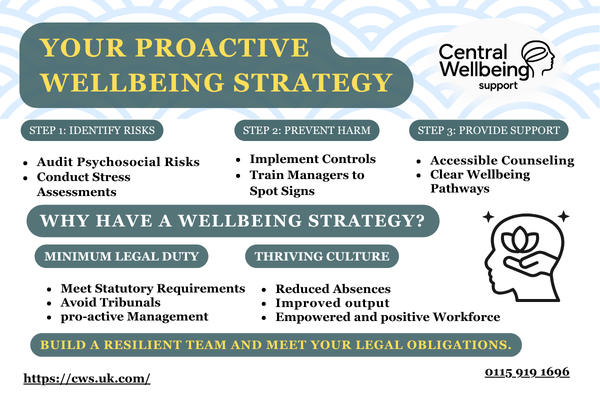
Meeting your legal duty of care isn’t just about avoiding a tribunal; it’s about creating a culture where staff can thrive. To effectively implement how to support employee mental health at work, consider these four pillars:
- Risk Management: Conduct regular stress risk assessments using the HSE Management Standards (Demands, Control, Support, Relationships, Role, and Change).
- Manager Training: Ensure your leadership team can spot the early signs of burnout and knows how to conduct sensitive “wellbeing check-ins.”
- Accessible Support: Provide pathways to professional help, such as counselling or therapy, that staff can access without fear of judgment.
- Clear Policies: Have a robust mental health policy that is communicated clearly from the top down.
Your Local Partner for Employee Wellbeing Support in Nottingham
Navigating the complexities of employment law and clinical mental health needs can be daunting. You don’t have to do it alone.
Central Wellbeing Services provides specialist employee wellbeing support in Nottingham, helping businesses bridge the gap between legal compliance and genuine care. We offer tailored solutions designed to meet the specific needs of professional organisations, including:
- Clinical Intervention: Rapid access to therapy and counselling for staff.
- Workplace Audits: Helping you identify psychosocial risks before they become legal liabilities.
- Training & Strategy: Empowering your Nottingham-based team with the tools to manage mental health proactively.
Protecting your employees is a legal obligation, but supporting them is a strategic advantage. By investing in professional employee wellbeing support in Nottingham, you reduce absenteeism, improve retention, and build a resilient workforce.
Take the Next Step in Your Duty of Care
Are you confident that your current mental health strategy meets the 2026 UK legal standards? Don’t wait for a crisis to find out.
Contact Central Wellbeing Services today to learn more about our comprehensive support packages and ensure your team has the expert care they deserve.
For further reading on official standards, visit the Health and Safety Executive (HSE) or consult the Equality and Human Rights Commission (EHRC).
